2026 Mobile Growth Strategy Guide
The definitive strategy guide for Rewarded Playtime, Programmatic DSP, OEM Discovery, and Apple Search Ads. Built for growth teams who need to scale smarter in 2026.
Trusted by leading brands worldwide
Scaling beyond walled gardens with AI, transparency, creative intelligence, and bid-level precision.
Mastering the value-exchange model through Rewarded Playtime and Offerwalls.
Reaching users at the source before they even open an App Store.
Mastering intent and managing cannibalization with a unified engine.
Market data sourced from Sensor Tower and Statista covering iOS App Store and Google Play downloads and revenue estimates through December 2025.
Campaign performance data aggregated from 10,000+ campaigns managed through AppSamurai's DSP, OEM, and Rewarded Playtime platforms across 2024-2025.
Creative analysis powered by Adjust examining 500,000+ ad creatives across iOS and Android to identify top-performing elements and trends.
In-app revenue figures are gross — inclusive of app store commissions. Download estimates are per-user, counting one download per Apple or Google account.
Distribution of app installs by acquisition channel. Organic still leads, but paid UA and OEM pre-loads represent the fastest-growing segments as competition for quality installs intensifies.
But paid channels are closing the gap fast
The Programmatic Engine — Navigating the Open Internet

AppsFlyer's State of App Marketing reports that during major sporting events (like the World Cup or Olympics), CPMs on social platforms spike by as much as 45%, whereas programmatic inventory in non-gaming utility apps remains stable, offering a 2.5x higher ROAS for brands that “zig when others zag.”

AppSamurai's strategic programmatic advertising expertise helped SHAHID boost user acquisition, drive subscriptions and strengthen our position as the leading MENA VOD service. Their partnership was vital to our mobile growth success.
Ali Aktas, Head of Performance, @Shahid
In 2026, the vanity metric of “cheap impressions” (CPM) has been officially retired. For sophisticated growth teams, the goal has shifted from winning the bid to using pre-bid intelligence to predict a post-install event before a single cent is spent.
Massive inventory beyond walled gardens
The industry has moved toward real-time machine learning that enables deep-funnel, CPA-based optimization. By identifying users with a high propensity for specific actions—such as reaching a gameplay milestone or starting a subscription trial—brands are achieving a more predictable and stable path to profitability.
Traditional social platforms often capture “passive scrolling,” leading to high ad fatigue. In contrast, programmatic inventory captures “active engagement” moments. Shifting spend to these high-receptivity lulls (e.g., between game levels or during utility tasks) ensures your brand reaches users when their cognitive load is primed for discovery, not just distraction.
To scale without losing efficiency, granular control is non-negotiable. Automated Whitelisting ensures your presence is consolidated on top-performing platforms that align with your core audience. Simultaneously, Automated Blacklisting acts as a dynamic shield, filtering out low-intent inventory in real-time so that as your budget grows, your waste doesn't.
You cannot scale what you cannot see. Success in the 2026 open internet requires total visibility into bid floors, session depth, and loss notifications. This level of bid-level transparency allows growth teams to uncover high-value “pockets” of inventory that others overlook, shifting the strategy from chasing volume to securing quality.
Creatives have become the new targeting. With granular ID-based targeting fading, the visual asset itself must do the heavy lifting of finding the right audience.
Through cultural authenticity in emerging markets
High-performing assets in 2026 are built on user psychology—addressing specific pain points, FOMO, or the desire for efficiency. When a creative resonates with a specific psychological profile, the algorithm naturally finds similar audiences.
Manual A/B testing is no longer viable at scale. The industry benchmark has moved toward AI-powered rotation, identifying winning visual hooks (like localized gameplay mechanics) in real-time.
Visibility is only valuable when it is contextually relevant. For high-volume platforms (such as those in the VOD and streaming space), tailoring creative themes to match local seasonal events or utilizing dayparting (aligning themes with peak viewing times) has become a primary lever for driving down subscription costs.
In 2026, localization has evolved far beyond simple translation. To scale effectively in global markets, ads must feel “native” to the local culture. Utilizing regional creators, local slang, and culturally relevant scenarios is now a strict performance requirement; in emerging markets, this has been shown to lower CPAs by up to 30%.
Creative data is now a primary insights engine. By analyzing which iterations drive long-term LTV rather than just clicks, brands are feeding these findings back into their broader product development.

iOS users respond well to a sound-off design (+24%), that open with close-up shots (+16%) of gameplay (+45%), introduce free-offer text early (+30%), and feature a large centered logo (+29%) at the end paired with the CTA text 'Play Now!' (+14%).
Source: Adjust

Android users respond well to videos that use sound effects (+12%), split-screen (+51%) scenes showcasing gameplay (+13%), and multiple scenes (+42%), with an end card that omits a CTA (+31%) but features falling coins (+11%).
Source: Adjust
With the full adoption of SKAN 5.0 and the Android Privacy Sandbox, 2026 is the year of “Signal Loss.” The most successful growth teams have stopped chasing deterministic tracking and started embracing Incrementality.
To prove incremental growth, brands use probabilistic modeling and lift testing. This ensures that programmatic spend isn't merely poaching organic installs but driving incremental scale.
High-performing creatives are now context-aware. Tailoring themes to match local seasonal events or “dayparting” (aligning ads with peak viewing or usage hours) has become a key lever in driving down the cost per subscription.
You cannot scale what you cannot see. The “black box” approach to programmatic is being rejected in favor of total supply-chain visibility.
Scaling requires granular control via automated whitelisting (targeting top-tier platforms) and blacklisting (filtering low-intent inventory).
Visibility into bid floors, session depth, and loss notifications is essential. This data allows growth teams to identify high-value “pockets” of inventory that competitors overlook, optimizing for quality over volume.
True growth in 2026 is a “leaky bucket” problem. Turning an install into a loyal user requires a three-phase retargeting framework.
Source: Statista
Source: Sensor Tower
Industry Benchmark
Not all dormant users are the same. The industry has moved toward Intelligent Segmentation based on inactivity duration and historical value. Users are segmented by churn risk: a user inactive 10+ days without purchases receives awareness messaging, while a high-value user inactive 7 days gets a personalized reward. The key is identifying the exact “churn window” for surgical intervention.
Retargeting moves active users deeper into the funnel through Strategic Timing and Frictionless Re-entry. Optimal Window Targeting (dayparting) pinpoints when users are most receptive. Direct Deep Linking bypasses the App Store, landing users exactly where they need to be, whether that's a product page, new feature, or pending game level.
AI engines identify and reward high-value segments for revenue outcomes. Cart Recovery serves time-sensitive rewards to users with abandoned carts. Loyalty programs drive repeat purchases through personalized deals. In gaming and fintech, “whale” retention keeps the highest-value users engaged with exclusive experiences.
The rest covers Rewarded Playtime (Chapter 2), OEM preloads on Samsung, Xiaomi, and Huawei (Chapter 3), and Apple Search Ads + ASO strategy (Chapter 4), plus the interactive ROI calculator.
Mastering the value-exchange model

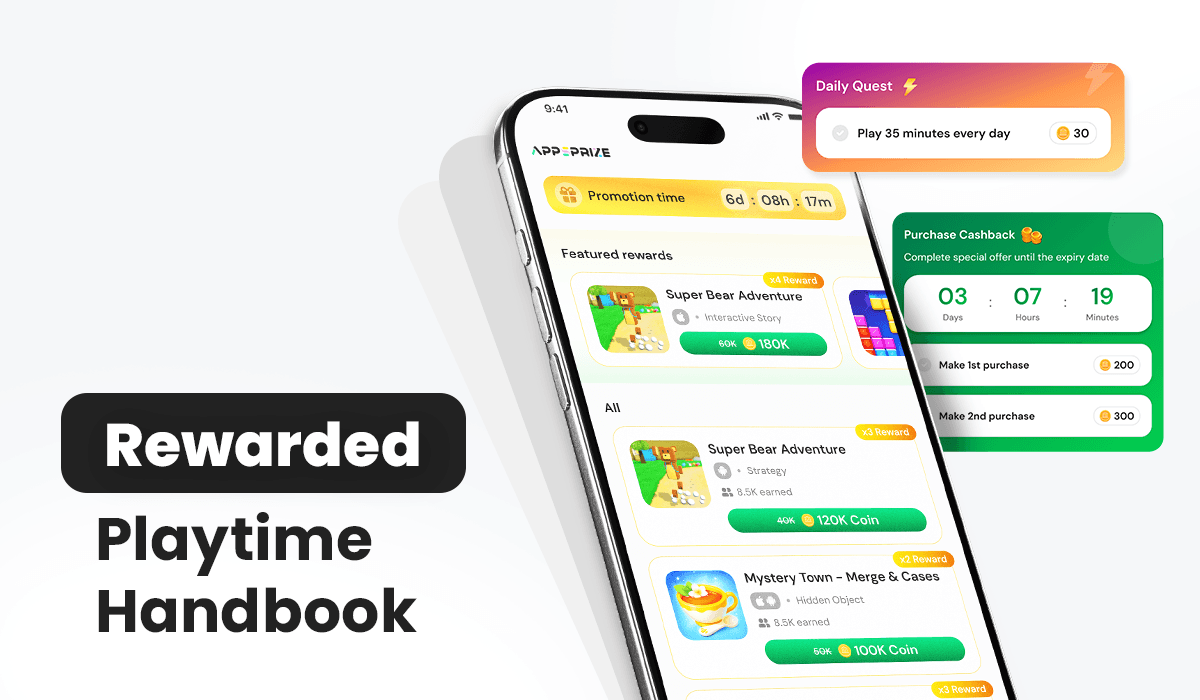
Rewarded Playtime rewards users based on actual time spent and milestones achieved within an app. Unlike traditional install-focused models, it fosters a continuous relationship from the first minute of gameplay.
From Day 1 metrics to 60-90 day sustainability
Developers are moving away from volatile Day 1 metrics and focusing on long-term sustainability by rewarding users over a 60-90 day period.
By analyzing mobile interests, demographics, and geographic data, growth teams can optimize each segment individually for maximum ROI.
The “Aha! Moment” is the specific point where a user recognizes the core value of an app. In a rewarded ecosystem, the structure is mapped directly to these milestones to ensure users don't just install, but “hook” into the experience.
Playtime uses event-based campaigns to reward users for every level completed. By continuously rewarding the user for their gameplay, the model drives extended session times and higher ARPU.
For titles like “merge” or “mystery” games, the focus is on repeated gaming sessions and user attachment. Playtime provides a visually appealing way to drive users to continue playing and become more hooked on the core gameplay loop.
For apps with mixed monetization strategies or complex onboarding (like FinTech or E-commerce), Playtime provides an entertaining rewards experience. This high-retention approach has a promising impact on revenue and LTV.
Achieving high conversion rates while maintaining strict CPI constraints requires moving from acquiring volume toward acquiring value.
Using precise age and gender targeting allows teams to bid accurately for each audience segment. This ensures you reach users more effectively and avoid the trap of acquiring low-quality users.
Initial tests with Playtime often reveal high retention rates. This stability allows growth teams to optimize segments individually and capitalize on the strengths of diverse audience groups, leading to a much more sustainable performance.

IAPs have become even more important for hypercasual game publishers, offering a more reliable revenue stream compared to the volatile nature of ad revenue. Through Rewarded UA we can reach a wider audience and attract players who are more likely to make in-app purchases while providing them with a richer gaming experience.
Mert Simsek, Co-founder & CMO at APPS
For publishers, maximizing yield in 2026 requires a monetization strategy that feels like a feature, not a disruption. This is the core philosophy behind AppsPrize.
AppsPrize acts as a loyalty layer, rewarding users in the app's native currency as they explore.
Built on playtime and level-based events, it inherently filters out low-quality traffic. Publishers provide a platform for verified user attachment.
A visually engaging way to discover new content, ensuring positive UX and greater attachment to both the advertised game and the host app.


On-Device Discovery

OEM ads appear at natural touchpoints: the home screen, lock screen, and within native system apps. They don't interrupt a user's session.
Reachable via OEM partners
| Format | Reach | Cost Efficiency | Best Use Case |
|---|---|---|---|
| PAI (Play-Auto-Install) | Very High | ▲ Best | App launch, first-day strategy |
| Icon Placements | High | ▲ Excellent | Brand awareness, sustained growth |
| Native Splash | High | ▲ Very Good | High-intent retargeting |
| Smart Push | Medium-High | ▲ Good | Re-engagement messaging |

PAI (Play-Auto-Install)
Icon Placement

Native Splash

Smart Push
The true power of OEM lies in the depth of data available at the hardware level. We've moved beyond simple age and gender filters to a fuller picture of user intent based on behavior and purchase signals.
Reach users based on their actual app usage patterns. Surface your game to users who frequently engage with similar genres.
Tailor campaigns to specific device models. Promote flagship titles on premium hardware, utility apps on the broader mid-range market.
Capture intent the moment a user searches for a solution, or re-engage users who interacted with your brand but haven't converted.
OEM advertising often provides lower entry costs compared to traditional digital channels, allowing for broader reach with less ad spend.
Precise targeting ensures that impressions aren't wasted on disinterested audiences. You aren't just buying reach; you are buying contextual relevance.
By moving away from the “noise” of crowded ad auctions, brands can stand out in an uncluttered system environment, building a lasting connection with the user at multiple stages of their journey.
ASA & ASO Synergy

The most successful strategies are rooted in CPA and deep-funnel event optimization.
We optimize campaigns to achieve a target CPA for registrations — ensuring the budget buys active users, not just downloads.
We prioritize keywords that yield high event conversion rates — tutorial completion, first purchase, profile setup — tying every dollar to long-term LTV.
| Keyword | Search Volume | Competition | Opportunity |
|---|---|---|---|
| puzzle games free | Very High | High | Brand + Generic |
| racing game | High | Medium | Discovery |
| idle tycoon | High | Low | Competitor Conquest |
| match 3 games | High | High | Brand Defense |
| action rpg | Medium | Medium | Category |
| strategy war game | Medium | Low | Long-tail |
Your brand name is your most valuable App Store asset. Defending your “home turf” is non-negotiable.
Maximize Share of Voice for your brand keywords. Competitors bidding on your name should never appear above you.
Use Custom Product Pages for specific features or promotions to capture competitor-related search intent.
Strategically bid on competitor brand names to capture users actively searching for alternatives in your category.
When you run high-impact campaigns via DSP or OEM, brand searches surge. By increasing your ASA presence during these periods, you capture 100% of that “manufactured” demand at the most efficient price point. ASA does not exist in a vacuum — it is the net that catches the demand created by your other channels.
Save the complete 2026 Growth Strategy Guide — all 4 chapters, charts, case studies, and frameworks.
AppSamurai is a global mobile growth platform empowering apps to scale through AI-powered programmatic advertising, rewarded user acquisition, and OEM on-device discovery.
Our integrated ecosystem — including the AppsPrize rewards platform — enables growth teams to acquire high-value users, optimize retention, and maximize lifetime value across every stage of the funnel.
Our growth team has helped 500+ apps scale with the exact strategies in this playbook. Let's build your custom growth plan.
Talk to Our Growth Team →